Sensory with Kylee

End the After-

School Meltdowns.

Get Your

Evenings Back.

Your Image

Price: $37

What's included?

✓ Why after-school meltdowns and dysregulation are so common. Your child isn't being difficult — they're exhausted. You'll finally understand what's happening in their nervous system and why the end of the school day is the hardest part.

✓ What dysregulation actually looks like — and what's really driving it. Whether your child comes home explosive, withdrawn, silly, or shut down, you'll understand what's going on beneath the surface and why the usual parenting advice often makes things worse.

✓ How to set your child up for a calmer afternoon before things go sideways. Small shifts in structure and predictability can take so much pressure off your child's nervous system — and off you.

✓ How to make the transition from school to home smoother. The first 30–60 minutes after school can either set the tone for a calm evening or send everything spiraling. You'll know exactly what to do with that window — and what to avoid.

✓ Simple strategies to help your child reset and recharge after a long day. Movement, snacks, and decompression tools that actually work — built around your child's needs, your home, and your real life.

✓ How to get through homework and chores without a meltdown. Timers, transition games, movement breaks, and one simple playlist trick that makes starting responsibilities feel almost automatic.

What to do when life doesn't go according to plan. Activities, sibling schedules, busy evenings — you'll have a rhythm that bends with your family instead of falling apart when things get unpredictable.

✓ What to do when your child is already dysregulated. You'll know how to spot the early signs, stay grounded when things get intense, and actually help — instead of accidentally making it worse.

✓ How to pull it all together into a plan that works for your family. You'll leave with a clear roadmap and the confidence that small, consistent changes really do add up over time.

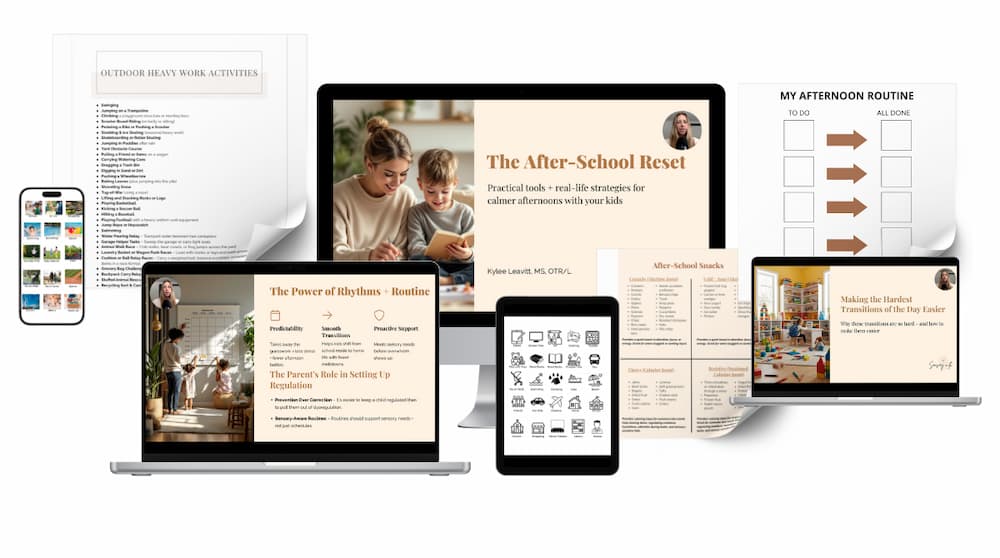
✓ [BONUS] Indoor Heavy Work Activity Guide, Outdoor Heavy Work Activity Guide, After-School Routine and Dysregulation Tracker, After-School Snack, Visual Schedule

Please note: Results may vary and are not guaranteed. Due to the digital nature of this product, we do not offer refunds.

School is almost over — is this still worth it?

Yes — and here's why. If your child is struggling now, those same patterns will show up again next fall. Summer doesn't reset the nervous system. Plus, these strategies apply to summer camps, vacations, and any time routine changes happen. Many parents find summer the perfect time to practice so that starting the new school year feels completely different. You're not just investing in this spring — you're investing in every school year that follows.

Will we need to stop after-school activities to make this work?

Not at all. In the course I teach you how to help your child reset and recharge on the way to activities and in between them — so you can keep doing everything your family already loves. This isn't about overhauling your schedule. It's about working smarter within the one you already have.

Do the concepts in this course apply to daycare, summer camp, or playdates too?

Absolutely! The concepts in this course go far beyond the school day. Whether your child is coming home from daycare, summer camp, a playdate, or any other busy or overwhelming environment, the same nervous system principles apply. Once you understand what your child needs to reset and recharge, you'll be able to support them in any situation — all year round.

How long is the course?

Just over 2 hours total, broken into short practical lessons. You don't need to watch it all at once — dip in, start implementing, and come back for more when you're ready.

What age does this work best for?

The strategies work best for preschool and elementary-aged children, though the concepts apply across a wide range of ages.

I've tried other strategies and nothing has worked. What makes this different?

Most parents have tried pieces of what their child needs — a sensory activity here, a routine there — but without understanding the why behind it, nothing sticks. This course starts with the nervous system first. When you understand what's actually driving the behavior, the strategies finally make sense and start working.

My child won't cooperate with routines or strategies. Why would this be any different?

Because this isn't about forcing your child into a routine — it's about setting up an environment that naturally supports their nervous system so they don't need to fight you on it. You'll also learn how to get your child on board by helping them understand why the routine helps them feel better. When kids understand the 'why,' cooperation comes a lot more naturally.

Our afternoons are already too busy. I don't have time for one more thing.

This isn't one more thing to add to your plate — it's a way to make everything on your plate easier. Even one or two small changes to the first 30 minutes after school can shift how the entire evening goes. The strategies are built for busy, real family life.

I'm already overwhelmed. I don't have the bandwidth to learn something new right now.

That's exactly why this course exists. You don't need to implement everything at once — you just need one thing that works. The lessons are short and practical, designed so you can watch a little at a time and start using what you learn right away. Small steps forward still move you forward.

My child doesn't have a diagnosis. Is this still relevant for us?

Absolutely. You don't need a diagnosis to benefit from this course — you just need a child who's struggling after school. Inside the course, I go into detail about how sensory processing works and how paying attention to your child's behaviors can give you a clear picture of what their nervous system needs. The way your child acts after school — whether they're bouncing off the walls, shutting down, seeking tight hugs, or melting down over small things — is actually valuable information. Those behaviors are clues. And once you know how to read them, you'll know exactly how to respond. As a pediatric OT, much of my clinical work has been with neurodivergent children — so if your child has sensory processing differences, ADHD, autism, or anxiety, you're in exactly the right place. But these strategies aren't exclusive to any diagnosis. We all have sensory needs, and this course works for every child who struggles after school.

Just fill out your info below to get access to The After-School Reset:

CONTACT INFORMATION

BILLING INFORMATION

COUPON

[[coupon_message.text]] [[cart_coupon.text]]

Payment Methods

Apple Pay selected.

Another step will appear to securely submit your payment information.

Google Pay selected.

Another step will appear to securely submit your payment information.

Subtotal:
[[checkoutContext.order.invoice.subtotal | currency]]
Tax:
[[checkoutContext.order.invoice.tax | currency]]
Shipping:
[[checkoutContext.order.invoice.shipping | currency]]
COUPON:
-[[checkoutContext.order.invoice.discount | currency]]
TOTAL::
[[checkoutContext.order.invoice.total | currency]]
[[subscriptionsByProductId[checkoutContext.order.invoice.items[0].product_id].plan_description]]